Alte Promotion von Quake 1 2 3

Alte Promo Features auf archiv.org.

Das Quake 1 Video zeigt wohl die Sega Saturn Version, hat riesige Schrifteinblendungen und bring am Ende angsteinflössende Bossgegner.

Das Quake 2 Video scheint die N 64 Version zu zeigen. Wer mal genau hinguckt, die Rocket Launcher Explosionen sehen super aus, keine Ahnung ob das echt ist.

Das Quake 3 Arena Video hat offensichtlich hinzu editierte Explosionen. Waffensounds haben einen netten Wumms. Seltsam sehen Teleporter und Brücke auf q3dm7 aus. Die Map war ja schon in den Test und Demoversionen vorhanden. Die Endsequenz vom Video ist nett.

Das Quake 3 Sega Dreamcast Video ist kurz und ich stelle mir seit 10 Jahren die Frage wie es wohl damals auf der Dreamcast war mit Controller einen Rocketjump zu machen. Ja ich weiss die DC hatte auch eine Maus aber die Mehrheit wird Q3 wohl mit einem Joypad gespielt haben.

Erinnerungen von John Carmack zum 15. Geburtstag von Quake

Am 22. Juni 1996 wurde Quake veröffentlicht. Zm Geburtstag sagt John Carmack im Bethblog ein paar Worte zur Entstehung von Quake 1. Magischer Moment sei gewesen als er auf einen Shambler blickte, es gab Zweifel an der freien Mauskontrolle (hihi), er traf seine Frau als die das erste Quake-Frauen-Turnier organisierte und mehr.

Als Extra verlinkt Bethesda auf ein Video welches den Release von QuakeWorld zeigt. QW ist der nachgereichte Multiplayer von id für Quake 1, er enthielt überarbeiteten Netcode auf Client Seite und sorgte für modernes Spielen über Internet. Bei den einen werden Erinnerungen wach, Jüngere können lachen über Spieler die Drehen statt zu Strafen oder sogar einen Joystick benutzen.

QuakeWorld wird natürlich noch immer mit Begeisterung gespielt, dass muss man trotz Nostalgie Faktor sagen. Einfach das Rundumpaket nQuake downloaden, installieren und einen von vielen Online Servern betreten.


Today marks the 15th birthday of Quake, the game that gave birth to online multiplayer shooters and even won an Emmy. In fact, Quake’s legacy is far too reaching to sum up here, so rather than pontificate ourselves, we got the id guys to say a few words before we blew out the candles.

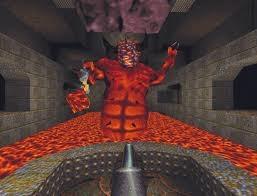
When asked to recall Quake, id Software president Todd Hollenshead offered this amusing anecdote: “One of my all time best game moments is still grabbing the rune at the end of the first episode and awakening the lava monster! I’m sure that level also inspired the USMC commercial with the Marine fighting the lava demon. Compare the screenie to the video. :)”

Also check out the video above, taken during the QuakeWorld launch event in 1996. The footage illustrates what a monstrous event Quake was in gaming history, and features a short historical Q&A session with John Carmack.

And finally, to cap off our celebration, a note today from the desk of Carmack himself:

“I could write an awful lot about Quake, but since we are in the final crunch for Rage right now, I’ll have to settle for just a few random thoughts.

I have a bit more subdued memory of Quake than many of our other projects, because the development was so tough. It was the first project where I really had to grapple with my personal limitations; I had bitten off a little more than I could chew with all the big steps at once – full 3D world, 3D characters, light maps, PVS calculations, game scripting, client / server networking, etc. No matter how hard I worked, things just weren’t getting done when we wanted them to.

My defining memory of the game was fairly early in development, when I no-clipped up into a ceiling corner and looked down as a Shambler walked through the world with its feet firmly planted on the ground. This looked like nothing I had ever seen before; it really did seem like I had a window into another world. Of course, as soon as he had to turn, the feet started to slide around because we didn’t have pivot points and individual joint modifications back then, but it was still pretty magical.

It seems silly now, but at the time we were very concerned that people wouldn’t be able to deal with free look mouse control, and we had lots of options to restrict pitch changes and auto-center when you started moving.

The internet gaming aspect was almost an accident. I had moved from Doom’s peer-to-peer networking to client/server primarily to allow late game entry, and UDP was supported because I was still doing a lot of the development on NEXTSEP unix workstations. The idea of playing over the internet was always there, but I didn’t think it would be practical for many people due to the long latencies and variable performance of typical connections. When it turned out that people were doing it despite the low quality, it gave me the incentive to develop the alternative QuakeWorld executable with the various latency reduction mechanisms.

The other important alternative executable was glQuake, which played a significant role in the early days of 3D accelerators. 3DFX was the gold standard back then – Nvidia’s RIVA128 had poor subpixel precision and didn’t handle all the blend modes properly. In fact, almost everyone was under the incorrect assumption that blending was only good for alpha transparency, even companies like 3DLabs that should have known better.

Competitive deathmatch had gotten started with Doom, but the Red Annihilation Quake tournament was a high point, where I gave my first turbo Ferrari away to Thresh for his dominating tournament win.

I look back at Quake as the golden age of game modding, before the standards rose so high that it required almost a full time commitment to do something relevant. I am very proud that many of today’s industry greats trace their start back to working with Quake.

The most important thing about quake for me was that I met my wife when she organized the first all-female Quake tournament. She still thinks Quake was the seminal achievement of Id, and she glowers at me whenever I bemoan how random the design was. :)”

Gepostet von Matt Grandstaff via Bethblog.com

57.000 Quakelive Spieler mit Christmas Award

Ein Spieler hat in einem Topic im Quakelive Forum eine Statistik über Spielerzahlen angegeben, wobei die wohl fehlerhaft ist.

Daraufhin hat ein Programmierer bei id Software gesagt, auf den Holidays / Christmas Maps wären mindestens 57.000 Spieler gewesen, soviele haben den Christmas Award freigespielt.

Über die Weihnachtsferien hätten 78.000 Spieler die Webseite besucht.

Quake 3 PRO Installer 2.0 veröffentlicht

Wer kennt das nicht, man möchte Quake 3 mal wieder installieren und denkt “oh Gott nein ich brauch sovieles, wird das anstrengend”. Für Quake 3 entstanden seit der 1999er Veröffentlichung immer wieder neue Maps und Mods. Und manche Online-Server setzen voraus das man den jeweiligen Mod oder die jeweilige Map schon hat.

Das Projekt PRO Installer hilft dabei die wichtigsten Mods und Maps zu installieren, also fast alles was allgemein für Quake 3 gebraucht wird. Benötigt wird zusätzlich zum Installer die pak0.pk3 Datei vom Quake 3-CD-Datenträger, denn aus rechtlichen Gründen darf diese Pak-Datei nicht beim Installer dabei liegen. (moddb/q3-pro-installer)

Quake Live Update 23.02 – Fixes, neue CTF Map, erweitertes Ingame Menü, Bloom Effekt

Ein grösseres Update hat am Dienstag Quake Live erfahren. Das Update bringt zahlreiche Bugfixes (esreality).

Einen neuen Award gibt es zu erhaschen. Wer in den nächsten 2 Wochen mindestens ein einziges Online-Match absolviert, bekommt den Award. Das sollte doch zu schaffen sein. id feiert 1 Jahr „Quake Live offenen Beta Test“, dazu gibt es eine schöne Zusammenfassung in schriftlicher Form. Ebenfalls findet eine neue CTF Map den Weg in Quake Live. Fallout Bunker stammt ursprünglich aus dem Q3 Add-On Team Arena. Aber das sehen wir nicht so eng.

Und leider wieder gibts ein paar unsinnige Dinge, wir sind das ja schon gewohnt (zB Erhöhung der Railfarben, von 7 auf 26 Farben). id kann einfach nicht aufhören uns alle möglichen Regenbogenfarben für jedes Detail zu geben. Spieler witzeln schon „again more colors?“. Doch einige Variablen werden andererseits sinnvoll begrenzt, da scheint id nun aufzuräumen: cg_trueLightning nur noch von 0.75 bis 1 möglich, cg_impactSparks ein/aus, cg_deadBodyDarken ein/aus. Also jetzt bei einigen Variablen keine einstellbaren Zwischenwerte mehr die eh keinen Sinn gemacht haben.

Kommen wir zum wirklich Positiven am Update. Das neue Ingame Menü. Wenn ihr eine Partie startet, dann Game Settings/Advanced wählt, werdet ihr erstaunen. Hier gibt es endlich viele Einstellungsmöglichkeiten für Quake Live die sonst nur durch bearbeiten der Config möglich waren. Für Anfänger und Fortgeschrittene ein Traum!

Auch nett, der neue Grafik-Filter-Effekt Bloom als Post Process der prompt im Ingame Menü zu finden ist. Damit können an Farben und Licht gespielt werden, z.B. soft erhellt bis grell, es ist auch möglich in schwarz-weiss zu spielen mit der Einstellung Saturation – während die Spielanzeigen weiter gewohnt farbig bleiben. Da freuen sich Moviemaker und Spielkinder :)

February 23rd Changelist

Overview:
New Map: Fallout Bunker – qzctf5
New Award: The First of Many!
New Post Processing Effect: Bloom (Requires hardware and driver FBO support)
New Menus: In-game Game Settings Advanced Menu

Changelog:

Add:

  • Added new arena, ‚Fallout Bunker‘ – qzctf5.
  • Added new award, ‚The First of Many!‘ – to celebrate the conclusion of the first year of QUAKE LIVE open beta.
  • Added r_enableColorCorrect <0|1> (default: 1). Toggle the Color Correction post processing effect (Requires r_enablePostProcess 1).
  • Added r_enableBloom <0|1|2> (default: 0). Toggle the Bloom post processing effect (Requires r_enablePostProcess 1).
    • Added r_bloomBrightThreshold <0-1> (Requires Bloom Enabled) The lower the threshold, the more will be bloomed.
    • Added r_bloomSaturation <0-10> (Requires Bloom Enabled) The higher the bloom saturation, the more colorful the bloom.
    • Added r_bloomIntensity <0-10> (Requires Bloom Enabled) The higher bloom intensity, the brighter the bloom.
    • Added r_bloomSceneSaturation <0-10> (Requires Bloom Enabled) The higher the scene saturation, the more colorful the non-bloomed world is.
    • Added r_bloomSceneIntensity <0-10> (Requires Bloom Enabled) The higher the scene intensity, the brighter the non-bloomed world is.
  • Added ‚postprocess_restart‘ command
  • Added cg_forceEnemyWeaponColor <0|1> (default: 0). Force enemies‘ grenades and rails to use ‚Enemy Upper Color‘ (cg_enemyUpperColor).
  • Added cg_forceTeamWeaponColor <0|1> (default: 0). Force teammates‘ grenades and rails to use ‚Team Upper Color‘ (cg_teamUpperColor).
  • Added Wide Beam lightning style (cg_lightningStyle 5), a nostalgic request from Q3 players.

Fix:

  • Fixed the ‚play <sound>‘ exploit that would allow you to play unpure .wav files that were named with .txt or .cfg file extensions.
  • Fixed the machinegun accuracy calcuation when firing at the Invulnerability Sphere, it was generating impossibly large accuracy values.
  • Removed artifact in large in-game font’s ‚0‘ character.
  • Fixed keel/sport head shader, removed stage with no image.
  • Fixed Hossman, Slammer, Stroggo skin shaders to prevent them being affected by picmip.

Chg:

  • Expanded our in-game Game Settings menu. New options can be found throughout Game Settings Basic and Game Settings Advanced menus, including ‚presets‘ that allow you to quickly choose between global configs or feature sets.
  • Expanded color range for railgun (color1 & color2) from 7 colors to 26 color choices.
  • Expanded color range for the crosshair (cg_crosshairColor, cg_crosshairHitColor) from 7 colors to 26 color choices.
  • Removed cg_weaponColor (replaced by new Force Weapon Color system).
  • Removed cg_weaponColorStyle (replaced by new Force Weapon Color system).
  • Changed the default value of com_hunkMegs from 56 to 96.
  • Changed the default value of cg_autoswitch from 1 to 0. If you wish to use the old default, set ‚Switch on Pickup‘ to ‚Yes‘ in the new in-game Advanced Game Options Menu.
  • Changed the default value of cg_lowAmmoWeaponBarWarning from 0 to 2.
  • Changed the default value of cg_drawItemPickups from 0 to 3. If you wish to use the old default, set ‚Item Pickups‘ to ‚No‘ in the new in-game Advanced HUD Options Menu.
  • Changed the default value of cg_hitBeep from 1 to 2. If you wish to use the old default, set ‚Hit Beep Style‘ to ‚Single Pitch‘ in the new in-game Advanced Sound Options Menu.
  • Changed the default value of cg_impactSparks from 0 to 1. If you wish to use the old default, set ‚Impact Sparks‘ to ‚No‘ in the new in-game Advanced Game Options Menu.
  • Changed the default value of cg_trueLightning from 0.75 to 1. If you wish to use the old default, set ‚Lightning Sway‘ to ‚Low‘ in the new in-game Advanced Weapons Menu.
  • Changed the default value of cg_deadBodyDarken from 0 to 1. If you wish to use the old default, set ‚Darken Dead Bodies‘ to ‚No‘ in the new in-game Advanced Game Options Menu.
  • The award ‚The Freshman‘ has been renamed to ‚The Face!!!‘

John Romero und id Software erinneren sich an QTest Veröffentlichung

QTest hat nun auch schon wieder 14 Jahre auf dem Buckel. QTest war damals nur der Multiplayer, doch mit Tricks liessen sich auch Monster dazuschalten die im Programmcode steckten.

Der Quake 1 Multiplayer enthielt damals schon alles, was einen modernen 3D Shooter ausmachte. Übrigens, Quake World & Bunnyhopping hielt erst später Einzug in den Multiplayer.

John Romero
erinnert sich auf seiner Seite an das Erscheinen der QTest Version.

Bethblog
bietet aktuelle Statements von id Software Mitarbeitern an zum damaligen Erscheinen der QTest Version.


Fourteen years ago today, the pioneering developers at id Software released QTest, the first public beta of the original Quake.

Contained within a massive 4.1mb package, QTest served as the first glimpse of many groundbreaking gaming features that we now take for granted. Realtime 3D graphics, mouselook support, built-in TCP/IP multiplayer; Quake ushered in an entirely new era of shooters, and we’re still feeling the aftershocks.

To mark the occasion, I asked the guys at id to share some of their memories of February 24, 1996. Read on for comments from John Carmack, Tim Willits, and more — along with a few stories from the team here at Bethesda.

John Carmack, Co-founder and Technical Director, id Software:

We were watching a live online chat when the upload went live.  When the first person got it, there was a great clamor for reports about what it looked like.  Unfortunately, one of the first things reported was “There is a turtle in the corner of the screen.”  I had a check in the code to draw that icon as a sign that you were running at 10 frames a second or less, so you should reduce quality settings to get a more playable experience.  Quake was one of the first PC apps where floating point performance was a critical factor, which meant that Intel’s Pentium processor had a huge lead over the competing AMD and Cyrix processors of the time, which had FPUs that were more similar to the 486.  A lot of systems weren’t really up to it.

We eventually removed the “turtle check” from our games, because some people felt that we were insulting their systems, but there was also an interesting effect that was a product of the times — we found that a lot of people would crank up the resolution until the frame rate dragged down to about 10 fps, regardless of their CPU speed.  Competitive gamers may disbelieve this, but for players that were more interested in the then-novel experience of exploring a modeled virtual world, getting the visual fidelity up above 320×200 resolution was important enough to make the game only barely-interactive.  Most people had to wait a bit longer for glQuake and the 3DFX Voodoo to start getting the best of both worlds.

Tim Willits, Creative Director, id Software:

I don’t personally have any good stories about releasing Qtest. I was too nervous to really enjoy the experience.I did like kicking everyone’s ass online in Quake before I was quickly bypassed in skill by any self-respecting Quake player.

Pat Duffy, Lead Artist, id Software:

I was 2 months out of college, attempting to make a living with an art degree. I had played Doom before, having discovered it hidden on a server in the college computer room, but it was Qtest that set me on the path to becoming a video game developer. I had landed my first job as a graphic designer and was working late hours when Robert told me I had to stop everything and go over to see Qtest. I didn’t know what it was, but when he said it was by the Doom guys I was on my way.

I remember sitting there looking around in-game after he loaded it up, I didn’t care about the networking model he was talking about, I just couldn’t believe how big a visual leap had been made from Doom (and everything else out there). While he began to dig deeper into what id was doing I kept looking at the game, walking around, shooting the walls, and being amazed by the lighting, art, and 3d rendering. I knew right then that this is what I needed to do with my life…and nowhere but id Software would be an acceptable studio, these guys KNEW what it was all about.  It took me 5 years to get my foot in the door at id, and every day since then has been another day at my dream job, working with some of the most talented people in the industry…all thanks to Qtest.

Adam Pyle, Community Manager, id Software:

I was seventeen years old, an avid fan of id Software and NIN.  Before the release of QTest there had been preview coverage in gaming magazines that piqued my interest, which made me keep my eye glued to any news coming out of id.  The day of its release became the start of a passion yet to be matched within my gaming universe.  I found the unique blend of tech and gothic themes and the unparalleled detail within a 3D world to be mesmerizing. But it was perhaps the soundscape that took me in like no other.

William Shen, Associate Designer, Bethesda Game Studios:

Looking back, seeing the NiN logo on the box of nailgun ammo for the first time is my sharpest memory. I think there’s something definitively 1990’s about all that. Quake and NiN. It was like a revolution of young male nerd anger. Also, Quake dude had an axe. A bloody axe. That’s hardcore.

Jason Bergman, Senior Producer, Bethesda Game Studios:

What I remember most about the release of QTest was the anticipation behind it. It was going to be INSANE. There had been some screenshots released, but really, there was so much we didn’t know. The community that had sprung up around Quake (well before its release) was enormous (or at least, it was by our standards at the time). People were waiting for QTest not just to play it, but also to start hacking it and working on level editors and other utilities (this was long before games shipped with modding tools, so people had to write their own).

It was really exciting to be part of that community. As a huge fan of Doom, and a fairly active member of the burgeoning Quake community, I was constantly refreshing sites like Blue’s Quake Rag (now Blue’s News), Redwood’s Quake Page (sadly defunct) and sCary’s Quakeholio (now Shacknews) for the latest news. When it was finally released, I was hanging out in the Java chat room on a site called Aftershock (run by Joost Schuur, who moved on to work at GameSpy fairly early on and has been there ever since). John Romero (THE John Romero!) hopped on the channel and announced that it was out.

I downloaded it as soon as I was able to get through to an FTP site (probably either CDROM.com or one of its many mirrors), rounded up some guys in my dorm and we played deathmatch for many, many hours. For a test release, there was a LOT of content in that thing…awesome weapons like the nailgun, full 3D graphics (!) and an early version of one of the greatest deathmatch levels of all time (DM2 forever!).

A lot changed between QTest and and that initial retail version of Quake, and I guess it probably seems quaint to people who are used to the constant stream of news over Twitter and the many big gaming sites these days, but the release of QTest was huge for the community back then. And those guys who couldn’t wait to start hacking the game? They’re now a Who’s Who of the gaming industry, and you’ll find their names in the credits of games like Modern Warfare 2, Left 4 Dead, Borderlands, Gears of War…pretty much any of the major shooters from the last few years (including subsequent games from id). The Quake community was tightly knit and very, very motivated. It was a pretty unique time in the gaming industry.

Also the game was awesome. Did I mention that?

Gepostet via Bethblog.com